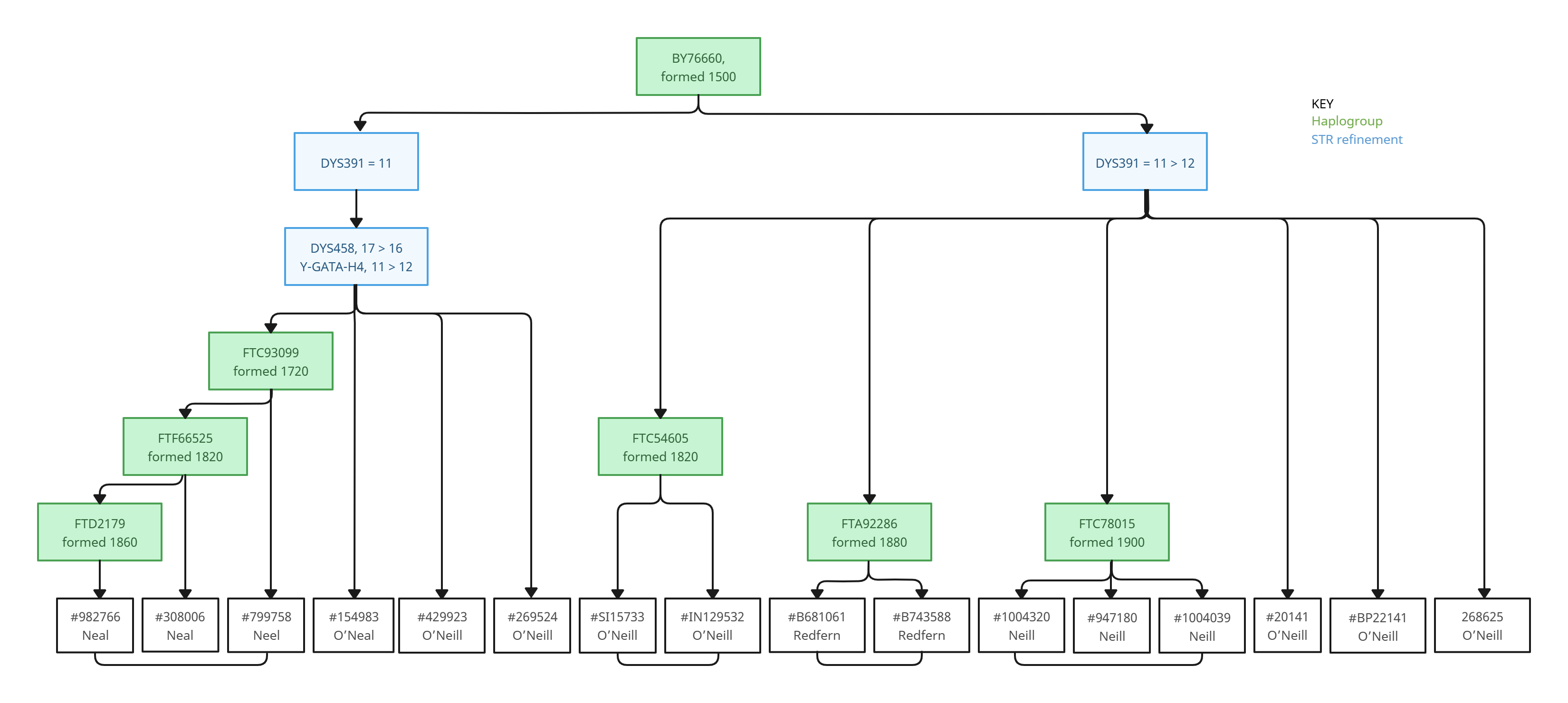
This first update covers what we now know about R-BY76660 from research activities I’ve been involved in since 2022. The figure below shows the DNA branching discovered from the Big-Y testers shown at the bottom, with privacy maintained. Green represents haplogroups and blue represents recent STR refinement. Dates in this interpretation are all FT Discover estimates, and conclusions drawn from research materials in PDF library. Thank you to all who participated in testing over the past two years.
Click here to Download Chart
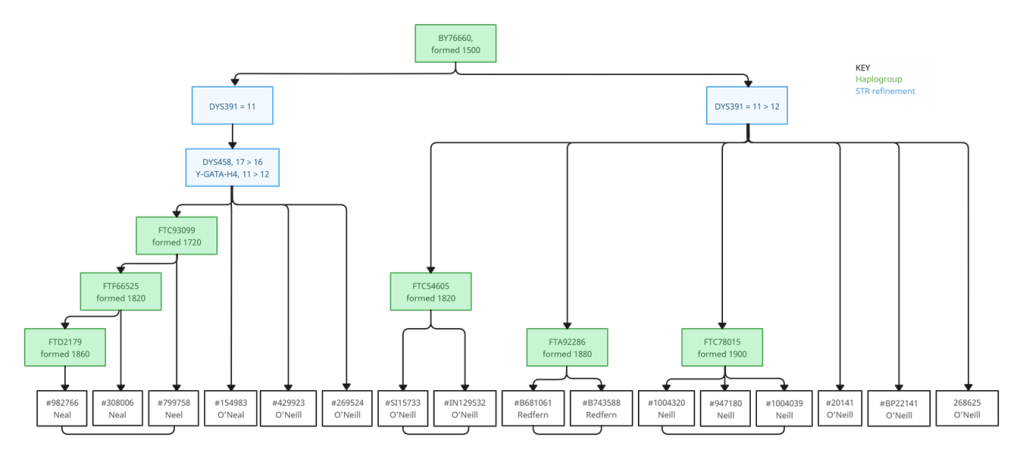
Cenél Eóghain branch R-BY76660 formed around 1500, and no later than 1580, with the birth of a common male O’Neill ancestor. He most likely lived in Loughinsholin in Tyrone, then part of the Clandeboye O’Neill’s Clandonnell territory and since 1613 part of Derry. He had about ten grandsons or great-grandsons with surviving lineages from two or more sons. They are represented by ten arrows that terminate with the haplogroups of present-day testers, roughly 20 generations later.
Data indicate there is a story to this man waiting to be discovered. Prior to the male O’Neill ancestor from around 1500, there were over 600 years with a singular male each generation keeping the lineage alive, indicating historical events had a harsh impact (and we’re all lucky to be here!). Suddenly, in the early 1500s fortunes reverse and boom with these ten men—for a time. The fall of Gaelic Ireland disinherited and randomly dispersed these families in the 1600s. By the 1700s, they had belonged to different communities throughout Ulster as Catholics, Presbyterians, and Quakers, when some began emigrating. While many remained in Ireland, many were also part of diaspora communities in America, Australia and New Zealand by the end of the 1800s. Yet now, with these ten grandson and great-grandson families having been separated from contact with each other for 400 years, there remains a remarkably consistent ancient tradition of descending from the O’Neill kings in Ulster.
Over the past two years amazing progress has been accomplished by various DNA projects in reconciling the DNA of our ancestors to the historical record. In the Cenél Eóghain Working Papers PDF Library, key Irish historical figures Conn Cétchathach, Niall Noígíallach (‘of the Nine Hostages’), and Eóghan are all evidenced as ancestors of R-BY76660. One of Eóghan’s sons was recently discovered to be the ancestor of both O’Devlin of Muntirevlin in eastern Tyrone and the R-BY76660 O’Neill, adding to our understanding and opening new pathways for interpretation. You can see this and the DNA details behind the chart above in the paper on FGC80436 by Dwayne O’Neill in the PDF library.
Exploring the R-BY76660 story is not a light task. The Royal O’Neill who emerged in 1176 do not have Cenél Eóghain DNA, both clarifying and complicating matters and requiring a reinterpretation of the historical record. The medieval accounting of royal bloodlines is sometimes wrong, and certainly purposefully wrong when it is, and it’s disproved by DNA of the Royal O’Neill and their predecessors, McLaughlin. While researchers are working to figure this out, more DNA testers are needed, particularly O’Neill men from Portglenone to Maghera in Derry. There is more to be discovered, but to do so a lucky break is badly needed!
 Cenel Eoghain O'Neill Working Papers
Leave a comment